
At Better View Landscape, we plan outdoor lighting around how you use your yard after dark. That means light on the steps you walk, the places you sit, and the features you want to see.
Signs Your Property Needs Outdoor Lighting
Your yard likely needs better lighting if you stop going outside after sunset or guests can’t find your front steps. That’s a sign the lights were never planned around how you use the space.
On larger lots around Davidsonville, long driveways and few streetlights mean the yard gets dark fast. In late fall and winter, the sun sets before dinner, so much of your home life takes place after dark.
- Steps and paths are hard to see. Stone steps, walkway edges, and grade changes are where people trip, so they need light first.
- Visitors can’t find the driveway. On a dark road with a long drive, a lit entry helps guests and delivery drivers find the turn.
- One floodlight does everything. A single bright light by the garage throws glare in your eyes and leaves deep shadows everywhere else.
- Your landscaping disappears at night. The trees, planting beds, stone walls, or water feature you paid for vanish after sunset.
- Old fixtures are failing. Burned-out bulbs, corroded fixtures, crooked stakes, or wire showing through the mulch mean the system is wearing out.
Most of these signs aren’t about brightness, so more light won’t fix them. A good plan puts soft light where you walk, sit, and want to look, and leaves the rest dark. That approach follows DarkSky International’s principles for responsible outdoor lighting, which emphasize directing light where it’s needed without making it brighter than necessary.
Fixture Types and Where They Belong
Each fixture type has one job. Put the right one in the right spot, and the yard is easy to walk and pleasant to sit in. The wrong one causes glare, hot spots, or a runway look along the path.
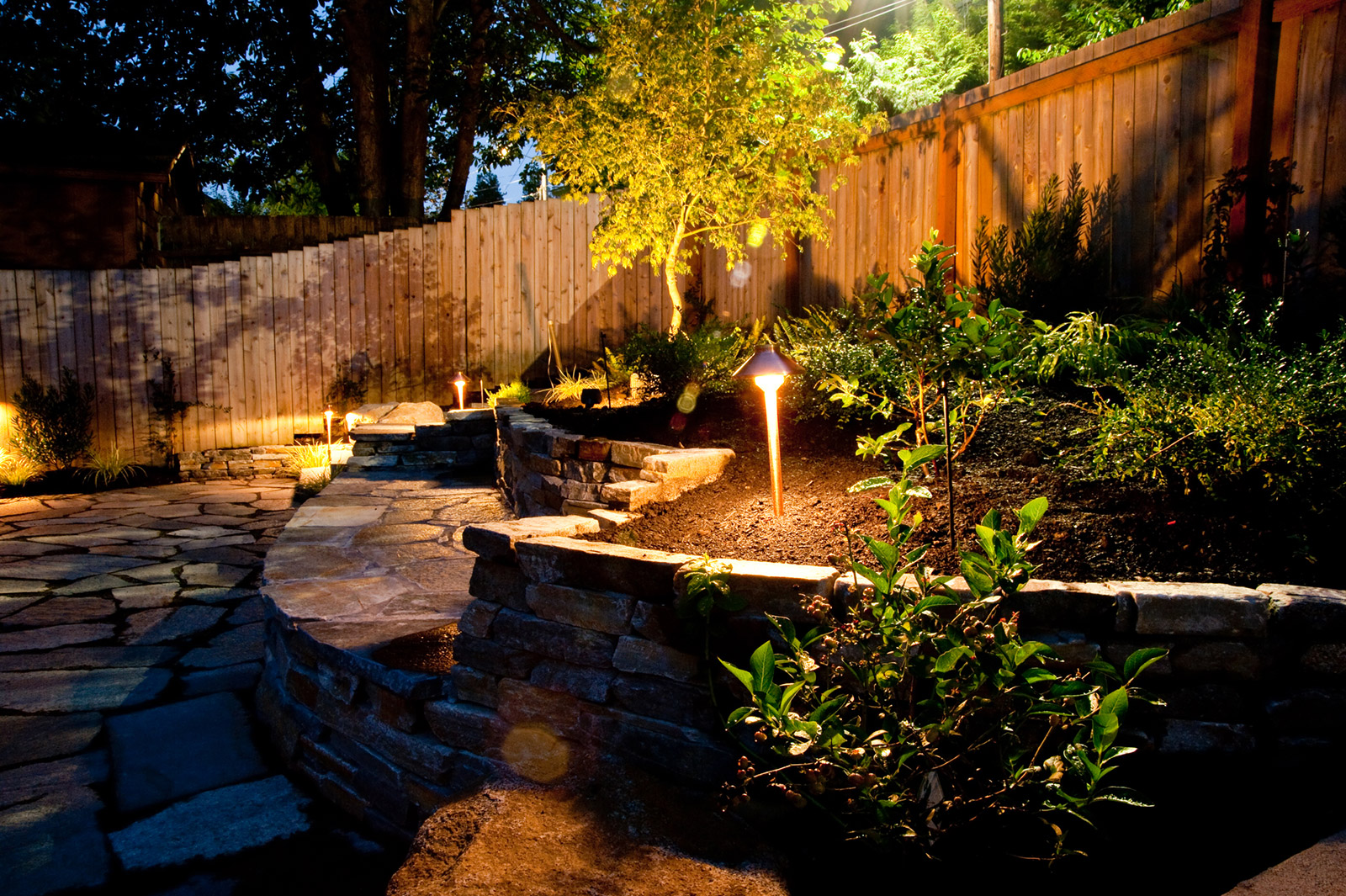
- Path lights. These short fixtures have a hat on top that throws light down and out. Stagger them along walkways rather than lining both sides, so light falls on the ground, not in your eyes.
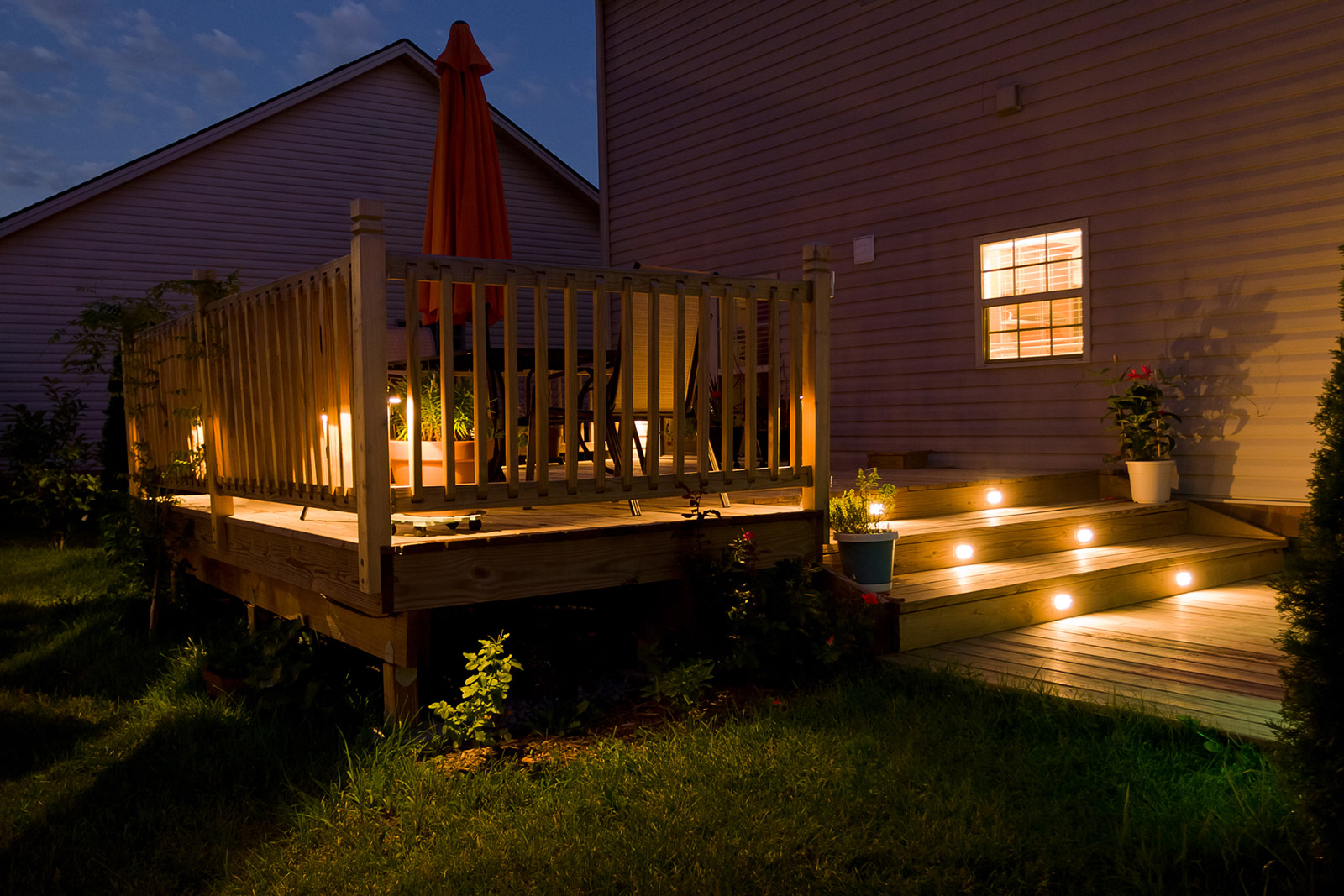
- Step and wall lights. These small fixtures tuck under a step or wall cap and wash light down the tread or stone. They’re the best choice for stone steps and grade changes.
- Uplights. These aim up from the ground at a tree canopy, a column, or the front of the house. On a lot with mature trees, one or two uplights on a big tree softly light the whole yard.
- Downlights. These mount high in a tree and point down, like moonlight through the branches. They work well over seating areas.
- Spotlights. A narrow beam aims at one thing, like a specimen shrub or an outdoor fireplace. Use only a few, since nothing stands out when everything is lit.
- Underwater lights. These go in a pond or under a waterfall and light the water from inside. Moving water catches the light, so the feature stays the focus after dark.
On a waterfront lot in Edgewater, aim fixtures toward the house and plantings rather than out across the water. That keeps glare out of your view of the water at night.
A good yard layers a few types, with low light for walking, soft light where you sit, and accents. Say your patio has a fire pit. Step lights mark the way to the lawn, and a downlight in a nearby tree lights the seating.
As a landscape lighting designer in Davidsonville, Better View starts with how you move through the yard and where you spend evenings. Then we pick fixtures to match, so no single light has to do every job.
Planning Lights with a New Patio or Walkway in Arnold
If a patio, walkway, or wall is on your list, plan the lights at the same time. Wire is much easier to run before the stone goes down, and the lights can become part of the build.
Once a paver patio is finished, the gravel base is packed tight and the joints are filled. Running wire across it later often means pulling up pavers or going the long way around the edge. Step and wall cap lights also look best set flush into the stone. Added later, they often end up on stakes in front of the wall.
When lighting is part of the plan from day one, a few things get simpler:
- Conduit, a plastic pipe that carries wire, goes in before the gravel base, so nothing gets dug up later.
- Step lights are built into the risers of stone steps as the steps are set.
- Wall lights are fitted into a sitting wall or retaining wall as it goes up, with the wire hidden inside.
- The transformer, the box that steps house power down to low voltage, goes somewhere handy and out of sight.
Before the build, think about where you’ll sit most evenings and which way you’ll walk to the patio or driveway. Your answers show where the light belongs, and that tells us where the wire goes.
Some Arnold neighborhoods have HOA review for exterior changes. If yours does, ask whether the board wants to see the lighting plan along with the patio plan.
When DIY Lighting Is a Reasonable Choice
You don’t always need a pro for outdoor lights. Some jobs are small enough for a weekend and a trip to the hardware store.
DIY makes good sense when:
- You want to light one short path or a single planting bed.
- You have a working outdoor outlet nearby and you’re using a plug-in low-voltage kit.
Solar stake lights are the easiest start, but they need sun to charge. Many yards across Anne Arundel County are shaded by mature trees, and winter days are short. Shaded panels may run out of charge early, though sunny beds do fine.
If your Crofton or Severna Park neighborhood has an HOA, check its rules on exterior lighting before you buy anything. And if a patio, walkway, or wall is coming in the next year, hold off on anything permanent. Fixtures staked in now may end up in the way of the build.
DIY gets harder once the job grows or the lights are built in:
- Long wire runs. On a big lot, lights at the far end of a run can look dimmer than those near the transformer.
- Many fixtures. Past a small kit, sizing the transformer and splitting the runs gets tricky. Mistakes show up as flicker, dim spots, or burned-out bulbs.
- Lights set into stone. Step and wall cap lights built into steps or walls take masonry work.
- New power. A new outlet or anything tied into your home’s wiring is a job for a licensed electrician.
If you can buy everything in one trip and finish in an afternoon, it’s probably a fine DIY project. If you’re drawing maps and counting feet of wire, the yard is ready for a real lighting plan.
What Drives Outdoor Lighting Costs in Annapolis
There’s no single price for outdoor lighting. Cost depends on what you light, how many fixtures that takes, and how hard each spot is to wire. A smaller Annapolis lot may need only a handful of fixtures, while a Davidsonville estate can need several runs.
Some installers quote per fixture, and others quote the whole project. Either works, but make sure two quotes cover the same work before you compare them.
These things push the cost up or down:
- Fixture count. A short path is a small job. Lighting the front yard, patio, and side path together is a much bigger one.
- Fixture material. Brass and copper fixtures cost more up front but tend to hold up better outdoors. Aluminum or plastic can fade, crack, or corrode sooner.
- Transformer size. More fixtures need a bigger transformer, and some yards need two on different sides of the house.
- Digging conditions. Trenching through open lawn is quick, but tree roots, heavy clay, or thick beds take more time.
- Built-in and specialty lights. Lights set into stone, mounted in trees, or placed in a pond take extra labor.
To keep costs down, light the places you use first, like the driveway path, the steps, and the patio. Choose fewer, better fixtures over a long row of cheap ones. Ask for a transformer with room to spare, so you can add lights in later seasons.
Before you hire anyone, ask:
- What are the fixtures made of, and what bulbs do they use?
- How many fixtures are in the quote, and where does each one go?
- How deep will the wire be buried, and how will it get past patios and walks?
- Is the company licensed with the Maryland Home Improvement Commission?
A clear quote should answer each one. If it’s vague on fixture count or materials, ask for details before you sign.
Why Homeowners Choose Better View Landscape
Better View Landscape is a local team based in Davidsonville, and our owners are involved in every project. You work with people who know your yard, not a rotating crew or subcontractors you’ve never met.
One team handles design and build, so the people planning your lights also plan the patio and walls around them. That keeps the wiring, stonework, and fixtures working together.
Before work starts, you get clear pricing, a timeline, and what to expect at each step. During the job, we keep you updated and show up when we say we will.
We build with care and quality materials, so your lights and stonework last for years, not one season. Better View Landscape LLC is licensed by the Maryland Home Improvement Commission, MHIC# 158957.
Frequently Asked Questions
How long does it take to install outdoor lighting?
It depends on the size of the job. A short path can go quickly, while a whole-yard plan with trenching around roots takes longer. We’ll give you a timeline before we start.
Can outdoor lighting be added after my patio or walkway is already built?
Yes, but hiding the wire takes more work. Running it across a finished patio usually means lifting pavers or routing around the edge. Planning ahead is simpler, but adding lights later works well too.
Will solar lights work on my property in Davidsonville?
It depends on how much sun it gets. Panels shaded by mature trees don’t charge well in short winter days, so they may fade early. In an open, sunny bed, solar stakes can work fine.
Plan Your Outdoor Lighting with Better View Landscape
Ready to see your yard at its best after dark? Call Better View Landscape at 410-921-1100 or use our contact form to set up a free consultation. We serve Davidsonville, Annapolis, Arnold, Crofton, Edgewater, and Severna Park across Anne Arundel County.